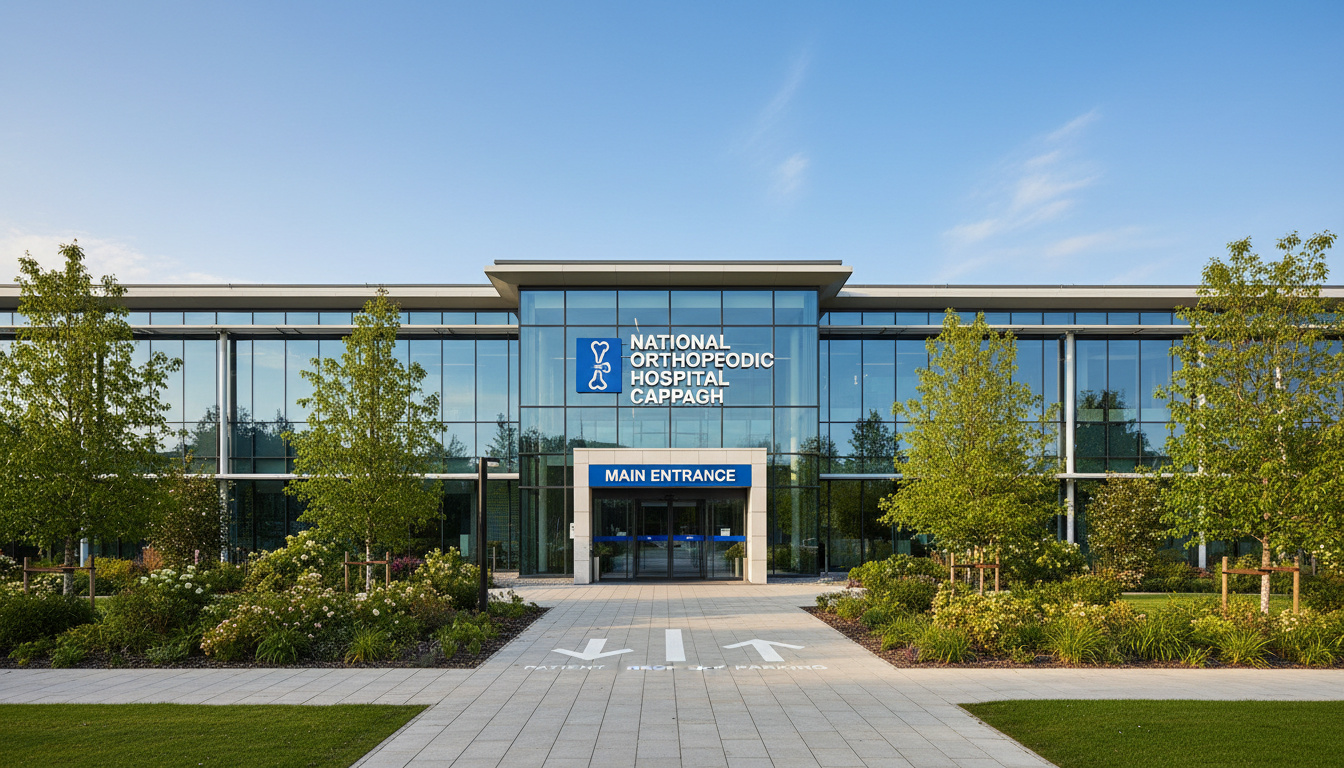
The National Orthopaedic Hospital Cappagh operates as Ireland’s largest dedicated orthopaedic facility, providing tertiary elective services to patients throughout the country. Located in Finglas, Dublin, the hospital functions under the management of the Ireland East Hospital Group and maintains a maximum occupancy of 160 beds. Its specialized units serve both adult and pediatric populations, integrating clinical practice with active research and education programs.
Originally established as Cappagh House, the site traces its origins to a 1907 bequest by Lady Martin, widow of Sir Richard Martin, who donated the property to the Religious Sisters of Charity for use as a school for poor children. The facility has since evolved into a major referral center supporting regional hospitals including St. Vincent’s University Hospital, the Mater, Beaumont, Connolly Hospital, Temple Street Children’s University Hospital, and the Central Remedial Clinic. A modern post-anesthetic care unit opened in 2016, reflecting ongoing facility development.
Where is National Orthopaedic Hospital Cappagh located?
Key facts about the hospital’s operations and significance include:
- Serves as Ireland’s largest orthopaedic hospital with specialized tertiary elective services
- Provides referral support to multiple Dublin regional hospitals
- Located on Cappagh Road in Finglas, accessible via public transportation
- Operates the dedicated Cappagh Kids service for pediatric orthopaedic cases
- Maintains interdisciplinary teams within state-of-the-art facilities
- Functions as a center of excellence integrating research with clinical care
Essential contact and location details:
| Category | Details |
|---|---|
| Primary Address | Cappagh Road, Cappoge, Finglas, Dublin 11, D11 EV29 |
| Alternative Address | 11 Cappagh Rd, Finglas West, Dublin 11, D11 CD71 |
| Geographic Coordinates | 53°23′39″N 6°19′47″W |
| Main Telephone | (01) 814 0400 |
| Cappagh Kids Freephone | 1800 807 050 |
| International Number | +353 1 240 8706 |
| Email Address | cappaghkidsenquiries@nohc.ie |
| Official Website | nohc.ie |
| Maximum Bed Capacity | 160 |
| Parking Availability | 154 spaces (9 disabled) |
| Bus Service | Routes 40D, 40E, 220 |
| Luas Access | Red Line at Broombridge |
What services does Cappagh National Orthopaedic Hospital offer?
The hospital specializes in tertiary elective orthopaedics, functioning as the nation’s primary center for complex musculoskeletal procedures. Interdisciplinary teams operate within modern facilities designed to support intricate surgical interventions while maintaining integration with ongoing research and medical education programs. HSE service listings confirm this structure positions the institution as a center of excellence within Ireland’s public healthcare framework.
Pediatric Orthopaedic Care
The Cappagh Kids unit provides specialized services for pediatric orthopaedic conditions, including surgical intervention for developmental dysplasia of the hip (DDH). Families can access the Family Information Line Monday through Friday from 8am to 8pm and Saturday from 9am to 5pm for guidance regarding pediatric treatments and appointments.
For pediatric orthopaedic enquiries, families can call the freephone line at 1800 807 050. International callers from outside Ireland should dial +353 1 240 8706. Email enquiries may be directed to cappaghkidsenquiries@nohc.ie.
Research and Education Integration
Beyond direct patient care, the hospital maintains active programs linking clinical practice with orthopaedic research and professional education. This integration supports the development of advanced treatment methodologies while training the next generation of orthopaedic specialists. The facility’s role as a tertiary referral center ensures that complex cases from affiliated hospitals receive specialist attention while contributing to broader medical knowledge.
How do I contact National Orthopaedic Hospital Cappagh?
Multiple contact channels accommodate different patient needs, from routine appointment queries to urgent pre-surgical consultations. The hospital operates specific phone lines for distinct service areas to ensure appropriate clinical guidance reaches patients efficiently.
Telephone and Digital Contact
The main hospital switchboard operates at (01) 814 0400. Patients scheduled for overnight surgeries who develop concerns or symptoms should contact 01 814 0448. Those attending for day case procedures can reach the appropriate department at 01 814 0445 during standard hours of 9am to 5pm. Virtual appointments are available through the hospital website for suitable consultations.
Payment Administration
The hospital accepts payments through several methods: online transactions, in-person payments at the Cash Office accepting cash, cheque, credit and debit cards, postal payments including cheque, bank draft or postal order addressed to Accounts Receivable, and telephone payments. Detailed payment information is available through the HSE hospital page.
Patients must not attend the hospital while experiencing cold or flu symptoms, following exposure to infectious illness, or when feeling generally unwell. Surgical patients requiring rescheduling should contact the specific numbers provided for their procedure type to prevent potential infection risks to vulnerable patients.
How has National Orthopaedic Hospital Cappagh developed over time?
The institution’s history reflects significant transformation from its origins as a charitable estate to its current status as a specialized medical center. This evolution tracks broader changes in Irish healthcare provision and orthopaedic treatment capabilities.
- 1907: Lady Martin, widow of Sir Richard Martin, bequeaths Cappagh House to the Religious Sisters of Charity for establishment as a school for poor children.
- 1951: Foundation of hospital services on the site, marking the transition toward medical use of the estate.
- 1996: Official designation as the National Orthopaedic Hospital, recognizing its specialized role within Ireland’s hospital network.
- 2016: Opening of a new post-anesthetic care unit, representing continued infrastructure investment and modernization of patient recovery facilities.
- Present: Operation as Ireland’s largest orthopaedic hospital with 160-bed capacity and comprehensive tertiary referral services.
The hospital’s development from a charitable school to a modern medical center illustrates the adaptation of healthcare facilities to meet evolving population needs while maintaining the original site’s community service mission.
What facts are confirmed versus unclear about the hospital?
Understanding the distinction between verified operational details and less documented aspects helps patients navigate services effectively. The following comparison clarifies established information against areas where specific details remain limited in public records.
| Established Information | Unclear or Limited Information |
|---|---|
| HSE-managed facility operating under Ireland East Hospital Group with HIQA regulation and inspection | Specific patient outcome statistics and detailed surgical success rates beyond general capacity figures |
| Maximum occupancy of 160 beds with confirmed integration into regional hospital networks | Detailed financial operational data and specific budget allocations for individual departments |
| Clear referral pathways from specific named hospitals including Mater, Beaumont, and St. Vincent’s | Comparative performance metrics relative to private orthopaedic providers |
| Confirmed public status with no indications of private ownership or operation | Future expansion timelines beyond the 2016 unit opening |
What role does the hospital play in Irish healthcare?
As the country’s largest dedicated orthopaedic center, the facility occupies a critical position within the tiered healthcare system. Its designation as a tertiary referral hub means complex elective procedures that exceed the capacity or specialization of general hospitals concentrate here, allowing for concentrated expertise and resource optimization. This concentration supports research into conditions including Sudden Adult Death Syndrome alongside orthopaedic care, though the hospital primarily focuses on musculoskeletal conditions. For those needing to file their taxes, the Tax extension deadline 2025 Ireland ROS provides important details.
The hospital’s integration with the Health Service Executive ensures that treatment remains accessible within the public system, while its educational component helps maintain workforce standards across Irish orthopaedics. Unlike planning around Rugby Fixtures This Weekend, scheduling medical appointments requires navigating clinical priority systems and waiting list protocols governed by medical necessity rather than calendar dates.
What sources verify information about the hospital?
Documentation for this facility draws from multiple authoritative sources including governmental health agencies and independent regulatory bodies. Health Service Executive records provide operational details and service specifications, while HIQA inspection reports verify regulatory compliance and quality standards.
Historical information regarding the site’s origins derives from archival records documenting the 1907 bequest by Lady Martin and the property’s transition from educational to medical use. Current service descriptions and patient guidelines originate from the hospital’s official website and HSE orthopaedic service listings. Transport accessibility details are confirmed through Dublin Bus service information.
What should patients prepare before visiting?
Successful navigation of care at this facility requires attention to specific protocols regarding health status, documentation, and transportation. Patients should attend appointments alone unless pediatric cases or disability assistance necessitate accompaniment, with older adults encouraged to bring a companion. Pre-appointment health screening remains essential; those with respiratory symptoms or recent infectious exposure must contact the appropriate departmental number to reschedule rather than risking contamination of the surgical environment. Parking requires payment at the main reception porch, with rates set at €2 per hour or €10 daily, while visitors should consult current website guidance regarding visiting hours and infection control measures including hand sanitization and potential mask requirements in clinical areas.
Frequently Asked Questions
Which public transport options serve the hospital?
Dublin Bus routes 40D, 40E, and 220 stop near the facility. The Luas Red Line serves Broombridge station nearby.
What are the parking costs at Cappagh Hospital?
The car park offers 154 spaces including 9 disabled spots. Parking costs €2 per hour or €10 daily, with the first 15 minutes free. Payment is made at the main reception porch.
Can children receive treatment at this hospital?
Yes, the Cappagh Kids unit provides specialized pediatric orthopaedic care including DDH surgery. A dedicated Family Information Line operates Monday to Friday 8am-8pm and Saturday 9am-5pm.
What payment methods are accepted?
The hospital accepts online payments, in-person payments at the Cash Office (cash, cheque, credit/debit cards), postal payments (cheque, bank draft, postal order), and telephone payments.
Should I attend my appointment if I feel unwell?
No. Patients with cold or flu symptoms, recent infection exposure, or general illness must not attend. Contact 01 814 0448 for overnight surgeries or 01 814 0445 for day cases between 9am-5pm to reschedule.
Are virtual appointments available?
Yes, virtual appointments are offered for suitable consultations. These can be accessed through the hospital website at nohc.ie.
What hospitals refer patients to Cappagh?
The hospital receives tertiary referrals from St. Vincent’s University Hospital, the Mater Hospital, Beaumont Hospital, Connolly Hospital, Temple Street Children’s University Hospital, and the Central Remedial Clinic.
What safety measures are in place for visitors?
Visitors must use hand sanitizing stations and may need surgical-grade masks or PPE in specific areas. Those with cold, flu, COVID-19, or viral symptoms are prohibited from visiting.