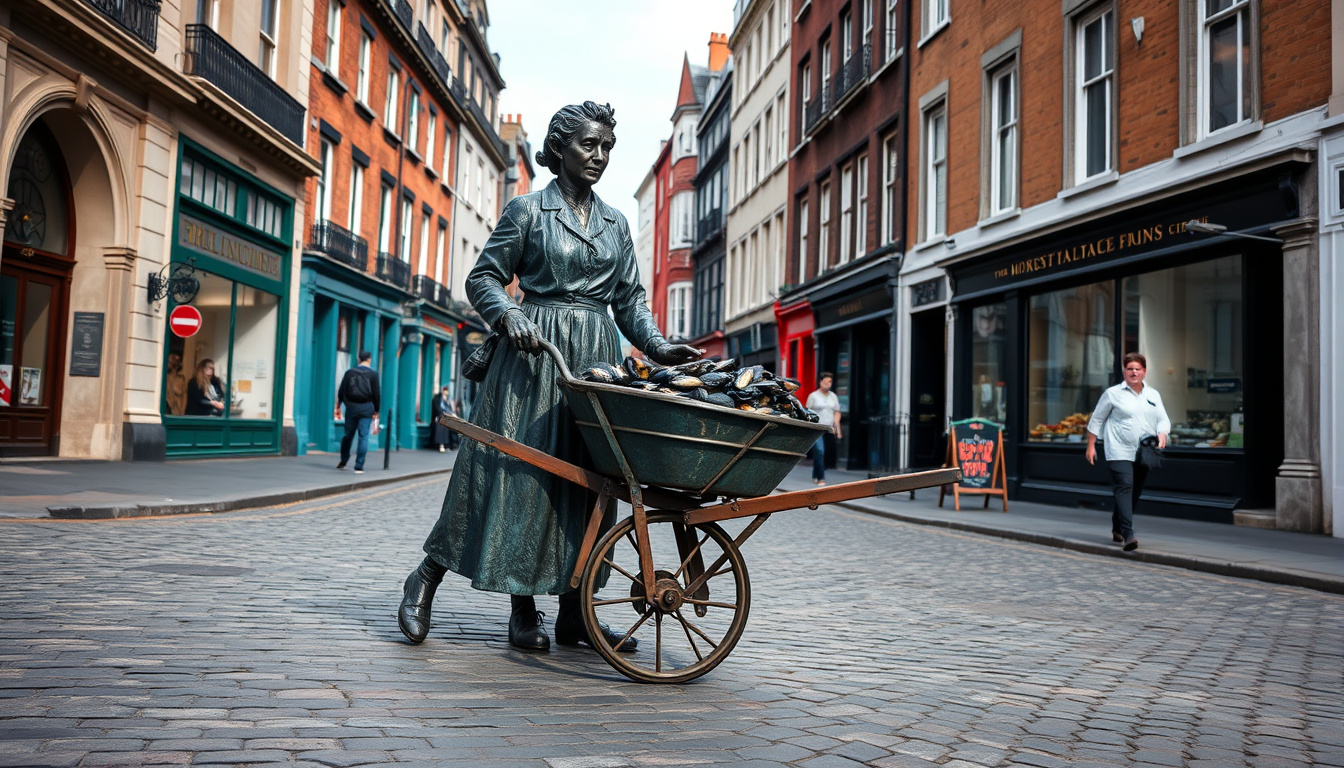
On Suffolk Street in Dublin stands a bronze woman in 17th-century dress, now flanked by stewards who politely but firmly ask tourists to step back. That statue is Molly Malone, and she’s become one of the most talked-about monuments in Ireland — not for her artistry, but for what’s been done to her over the past decade. Between the legend, the controversies, and the very real questions about who Molly actually was, there’s a lot more to this statue than meets the eye.
Location: Suffolk Street, Dublin · Unveiled: 1988 Dublin Millennium · Designer: Jeanne Rynhart · Status: Dublin’s most photographed statue · Legend era: 18th century hawker
Quick snapshot
- Whether Molly Malone was a real historical figure (History Ireland)
- Actual age and cause of death from any verified records (History Ireland)
- Authenticity of burial link to St John’s Graveyard claims (History Ireland)
- 17th century: Possible real Molly burial record
- 1880s: Ballad first published
- 1988: Statue unveiled for Dublin Millennium
| Detail | Value |
|---|---|
| Current Location | Suffolk Street, Dublin |
| Installation Year | 1988 |
| Artist | Jeanne Rynhart |
| Song Origin | 1880s ballad |
| Annual Event | Molly Malone Day, June 13 |
| Original Location | Grafton Street |
| Relocation Date | July 2014 |
| Commissioner | Lord Mayor Ben Briscoe |
Why do people touch the Molly Malone statue?
The tradition of touching Molly Malone’s statue for good luck started around 2012, possibly sparked by a single tour guide telling visitors that rubbing her breasts would bring fortune. The practice spread quickly through social media and walking tours, and by some accounts, up to 70 tourists per hour were groping the statue during peak times, according to Prospect Magazine. The touching has caused visible discoloration around the statue’s neckline and raised concerns from Dublin City Council Arts Officer Ray Yeates, who noted the groping creates “worry, discomfort, and safety risks from climbing,” according to RTE.
Groping tradition origins
Dublin historian Donal Fallon describes the touching as an “invented tradition” similar to the love locks that appeared on the Ha’penny Bridge — something that emerged organically rather than from official cultural roots. The practice had no basis in the original song or historical accounts of Molly Malone, according to Prospect Magazine.
Recent controversies
In 2024, Trinity College Dublin student and busker Tilly Cripwell launched the “Leave Molly mAlone” campaign after witnessing the groping firsthand, calling it disrespectful to what she described as “our national monument to the lady,” as reported by Irish Times. Local Dubliner Frank Monaghan echoed those concerns, stating that touching the statue is inherently disrespectful, according to the same Irish Times report. Dublin City Council responded by announcing a stewards pilot scheme set to begin in May 2025, as documented by RTE.
What is the story behind Molly Malone?
Molly Malone is a semi-mythical figure from a Dublin street ballad that first appeared in print during the 1880s. The song describes her as a fishmonger who sold cockles and mussels in the streets of Dublin, dying young from a fever, with her ghost reportedly still crying out her wares in the city, according to EPIC Museum. The Dublin Millennium Commission in 1988 took a playful approach to the legend by appointing a Mary Malone from 1699 as the “official” Molly Malone, though this was largely symbolic rather than historically grounded, according to Irish American Mom.
The ballad origins
The song “Molly Malone” has been called Dublin’s unofficial anthem, but its exact origins remain murky. No confirmed historical records of a real fishmonger by that name exist, and historians disagree about whether the ballad reflects an actual person or was entirely fictional from the start, according to Questo. Dublin historian Catherine Scuffil claims there is increasing evidence that a real Molly existed in The Liberties area, though she acknowledges the documentation is thin, as reported by RTE.
Hawker and oyster seller
Whether real or fictional, Molly’s legend centers on her daily routine: pushing a wheelbarrow through Dublin’s streets selling seafood, then dying young of fever, according to Irish American Mom. The statue depicts her in 17th-century dress with a notably low neckline — a detail that later became central to the touching controversy. Sculptor Jeanne Rynhart researched historical background to inform her work, incorporating elements of the evolving legend, according to History Ireland.
Dubliners nickname the statue “the tart with the cart,” a affectionate but irreverent term that captures how the city holds Molly simultaneously as a cultural symbol and a target for mischief.
What did Molly Malone sell in Dublin?
Molly Malone sold cockles and mussels — that much is clear from the famous ballad lyric that has become Dublin’s unofficial anthem. The song’s refrain — “Cockles and mussels, alive, alive-oh” — references the seafood she pushed through the streets in her wheelbarrow, according to EPIC Museum. The ballad describes her working as a fishmonger by day, with a darker implication in some versions that she supplemented her income as a prostitute near Trinity College at night, according to Viabam Tours.
Street vending trade
In 17th and 18th-century Dublin, hawking fresh seafood through crowded streets was a common trade for women, making Molly’s story plausible as a composite of real working-class Dubliners rather than a single individual, according to History Ireland. The wheelbarrow detail in the statue reflects this street-level commerce, with Molly frozen mid-push on Suffolk Street.
Song references
The ballad’s lyrics go beyond simple commerce to hint at a tragic end: “She was a fish and fish-ball seller / But that did not seem to end her / She is dead now, God knows where.” The ghostly element — Molly’s spirit still crying out her wares — has become central to Dublin’s folkloric identity, according to EPIC Museum.
Is Molly Malone a true story?
The honest answer is: partially. The ballad dates to at least the 1880s, but no confirmed historical records verify a real fishmonger named Molly Malone, according to Questo. Historian Sean Murphy has documented that a false legend emerged in recent decades claiming Molly was buried in 1734 at St John’s Graveyard, but he notes no supporting evidence for baptism or burial records exists, as documented by History Ireland.
Historical evidence
Some theories claim Mary Malone died on June 13, 1699, supported by a supposed birth certificate linking to the fishmonger legend, but these claims remain unverified, according to Viabam Tours. The Dublin Millennium Commission appointed a Mary Malone from 1699 as the “official” Molly in 1988, but this was a ceremonial gesture rather than a historical determination, according to Irish American Mom.
Myth vs records
Dublin historian Catherine Scuffil argues there is increasing evidence that Molly was real from The Liberties area, though she acknowledges the documentation is fragmentary, as reported by RTE. Her connection to sculptor Jeanne Rynhart adds personal stakes to the debate, though she has been clear that groping was not what was intended for the piece, according to the same RTE report.
The 2025 stewardship pilot may indirectly generate new historical research as Dublin City Council and local historians use the statue’s protection as an opportunity to reassess Molly’s documented roots.
Why is the Molly Malone statue famous?
The Molly Malone statue is Dublin’s most photographed monument, a distinction earned partly through its central location near Grafton Street and Trinity College, and partly through the controversies that have surrounded it since installation. Unveiled in 1988 during Dublin’s Millennium celebrations by Lord Mayor Ben Briscoe, it was originally placed on Grafton Street before moving to Suffolk Street in July 2014 to accommodate Luas tram construction, according to Wikipedia. The statue has become a cultural touchstone comparable to Copenhagen’s Little Mermaid or Brussels’ Mannekin Pis, representing both civic pride and the messy reality of how tourists interact with public art, according to Prospect Magazine.
Tourist interactions
The statue draws visitors who seek it out specifically for the touching ritual, creating a cycle where the tradition perpetuates itself through social media and tour guide recommendations. The practice started around 2012 and accelerated through the 2010s and 2020s, reaching what observers describe as peak groping frequency in 2023-2024 before the campaign and council intervention, according to RTE.
Cultural icon status
Dublin designates June 13 as Molly Malone Day, celebrating the figure who embodies the city’s complicated relationship between myth and reality, commerce and folklore, according to Questo. Dublin historian Donal Fallon notes that the statue was “a much-needed feelgood moment for the city in a decade recalled for emigration, drugs and other challenges,” providing context for why Dubliners have embraced Molly despite her uncertain origins, according to Prospect Magazine.
The statue’s fame now rests on a paradox: it became most famous for the very behavior (groping) that Dublin is now actively trying to stop.
Confirmed
- Statue erected 1988 on Suffolk Street
- Song about fishmonger dates to 1880s
- Tourist touching tradition started around 2012
- Stewards pilot begins May 2025
- Commissioned by Lord Mayor Ben Briscoe
Unclear or disputed
- Historical existence of Molly Malone
- Actual death age and cause from verified records
- Authenticity of 1699 Mary Malone connection
- Whether legend reflects real 17th-century hawker
“To touch the breasts or whatever of the statue is in itself disrespectful… That’s very disrespectful in my opinion.”
— Frank Monaghan, Dubliner (Irish Times)
“It was a much-needed feelgood moment for the city in a decade recalled for emigration, drugs and other challenges.”
— Donal Fallon, Dublin historian (Prospect Magazine)
The Molly Malone statue occupies an unusual position in Dublin’s cultural landscape: a monument to a possibly fictional fishmonger that has become more famous for what’s done to it than for its artistry. The touching tradition — barely a decade old — transformed the statue into something its sculptor Jeanne Rynhart never intended, while the historical debate about whether Molly was real continues among academics with thin documentation on both sides. Dublin City Council’s decision to station stewards at the statue starting May 2025 marks a formal acknowledgment that the city’s relationship with its most photographed monument requires active management rather than passive acceptance.
For visitors to Dublin this summer, the choice is straightforward: photograph Molly Malone respectfully from a distance, or become part of a problem the city has officially decided to solve.
Related reading: Houses for Sale Dublin 6
Frequently asked questions
Where is the Molly Malone statue located?
The statue stands on Suffolk Street in Dublin, near Trinity College, having been moved from Grafton Street in July 2014 to make way for Luas tram construction, according to Wikipedia.
When was the Molly Malone statue installed?
The statue was unveiled in 1988 during Dublin’s Millennium celebrations, sculpted by Irish artist Jeanne Rynhart and commissioned by Lord Mayor Ben Briscoe, according to Questo.
What song is associated with Molly Malone?
The ballad “Molly Malone” dates to at least the 1880s and has become Dublin’s unofficial anthem, featuring the famous refrain “Cockles and mussels, alive, alive-oh,” according to EPIC Museum.
Is touching the statue for good luck real?
The touching tradition started around 2012 and is an invented custom, not a historical practice tied to the original legend. Dublin City Council is actively working to stop the behavior through a stewards pilot beginning May 2025, according to RTE.
Has the statue been moved?
Yes, it was originally unveiled on Grafton Street in 1988 and relocated to Suffolk Street in July 2014 to accommodate Luas light rail construction, according to Wikipedia.
What is Molly Malone Day?
Dublin designates June 13 as Molly Malone Day, celebrating the semi-legendary figure whose story is tied to the city’s folkloric identity, according to Questo.
Who sculpted the statue?
Irish artist Jeanne Rynhart designed and sculpted the statue, researching historical background and incorporating elements of the evolving legend, according to History Ireland.