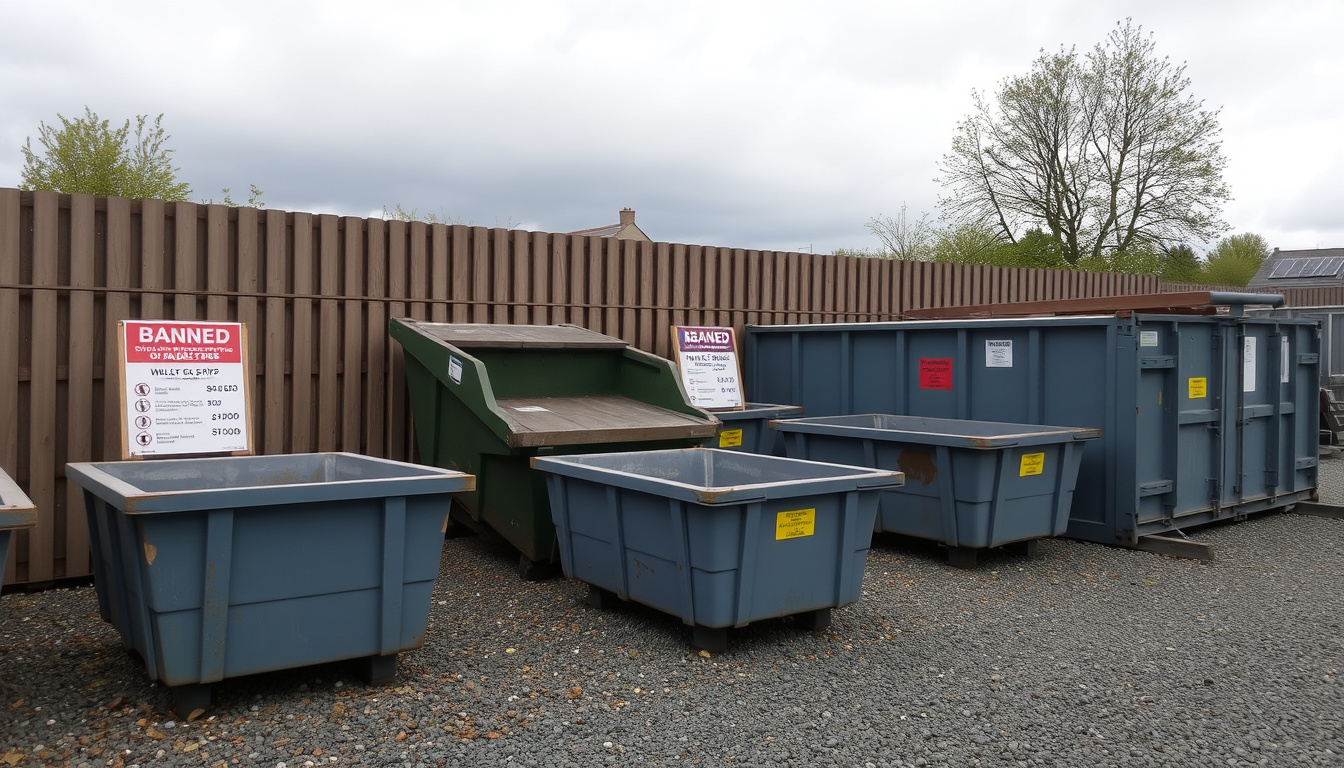
Anyone who has priced a skip for a home clear-out in Ireland knows the pattern: the headline quote looks great, until the weight limit, the prohibited list and the collection day start talking. A 2026 county-by-county guide from Hire a Skip Online (Irish skip-hire price guide) puts Dublin 2-yard hires at €167, while Kollect (Irish skip hire provider) advertises all-in hire from €194 covering delivery, collection, disposal and VAT. The gap between those two numbers is where the real cost of skip hire lives.
Lowest Dublin 2-yard quote: €167 (Hire a Skip Online, 2026 guide) ·
All-in skip hire from: €194 (Kollect) ·
2.5-yard mini skip from: €185 (KeyGreen) ·
Dublin 4-yard: €220 (same 2026 guide) ·
Cork 4-yard: €216 (same 2026 guide)
Quick snapshot
- All-in Irish skip hire from €194 including delivery, collection, disposal and VAT (Kollect).
- Dublin 2-yard skips listed from €167 in the 2026 county-by-county guide (Hire a Skip Online).
- KeyGreen’s mini skip from €185 with an 800kg weight cap and three-day hire period (KeyGreen).
- Exact 6-yard prices in rural areas, where haulage costs vary sharply.
- Whether all providers accept mattresses for a fee or refuse them outright.
- Whether hazardous-waste disposal fees are consistent across Dublin, Cork and Galway.
- The 2026 guide lists Dublin skips spanning €167–€458 and Cork reaching €714, a spread driven by size and haulage distance (Hire a Skip Online).
- KeyGreen already prices on a three-day hire cycle, shorter than the traditional weekly rental (KeyGreen).
- Before booking, check weight limits and prohibited items; overage and uplift fees typically run €20–€50 extra.
- Ask about plasterboard, mattress and electricals fees up front to avoid a refused load on collection day.
One pattern runs through every 2026 price list reviewed: the quote climbs with size, and the county you are in decides how much headroom the low end leaves you.
The spread across providers reveals a market split between headline-grabbing entry prices and all-in quotes that absorb the hidden costs.
| Fact | Value | Source |
|---|---|---|
| Dublin 4-yard skip | €220 at the low end; typical provider quotes €230–€300 | Hire a Skip Online (2026 county guide) |
| Most commonly quoted skip size | 4 yard | Provider price guides reviewed for this article |
| Typical hire period | 7-day hires are common; KeyGreen quotes 3-day periods | KeyGreen (Irish waste management provider) |
| Prohibited items (common) | Paint, plasterboard, mattresses, electricals | Provider price guides reviewed for this article |
| Weight limit per skip | 800kg on mini skips up to 2,500kg on large skips | KeyGreen |
| All-in skip hire from | €194 includes delivery, collection, disposal and VAT | Kollect (Irish skip hire provider) |
| Dublin 2-yard from | €167 | Hire a Skip Online |
| Cork 4-yard from | €216 | Hire a Skip Online |
| 14-yard skip | €458 in Dublin; €670 at KeyGreen | Hire a Skip Online; KeyGreen |
| 14-yard skip restriction | Not suitable for soil, stone or rubble at KeyGreen | KeyGreen |
How much does it cost to hire a skip in Ireland?
Skip hire prices in Ireland are a spread, not a single number. According to Hire a Skip Online’s 2026 county-by-county guide, Dublin quotes run from €167 for a 2-yard skip to €458 for a 14-yard skip, while Cork stretches to €714 for the same top size. Between those extremes sit the factors that decide your final bill.
Kollect takes a different route: one all-in price from €194 that folds in delivery, collection, disposal and VAT (Kollect). Translating that into a per-yard comparison misses the point — the real comparison is between a quote that can move and a quote that locks the job in.
What factors affect skip hire prices?
- Size: 2.5-yard entry skips sit well below 14-yard XL skips in every 2026 list.
- Location: Dublin 2-yard from €167, Cork 4-yard from €216 — haulage and local disposal costs are built into the difference.
- Weight limit: KeyGreen’s mini skip allows 800kg, so heavy waste changes the quote immediately (KeyGreen).
- Hire period: KeyGreen quotes three-day windows; other providers build weekly rental into the price.
- Prohibited items: paint, plasterboard, mattresses and electricals are either billed as extras or refused.
The trap is treating the headline price as the final price. A quote that looks €30 cheaper can flip once the provider weighs the load, spots a banned item, or adds a second collection.
How much does a 4-yard skip cost in Dublin?
- Dublin 4-yard: €220 (Hire a Skip Online, 2026 guide).
- Cork 4-yard: €216 (same 2026 guide).
- Kollect’s 4-yard small skip: all-in pricing from €194, roughly 30–40 bin bags (Kollect).
- KeyGreen’s 4-yard midi skip: €250 with a 1,500kg weight cap and a three-day hire period (KeyGreen).
At 4 yards, Dublin and Cork are nearly identical. The gap starts at 6 yards, where Cork quotes €379–€524 (same guide), and widens further at 8 and 14 yards — which is why the county guide matters more for big jobs.
Dublin’s €167 2-yard price is a door-opener, not a final invoice. Add an overweight load or a prohibited item, and the saving over an all-in €194 hire disappears.
The pattern is consistent: the cheapest per-yard quote is not always the cheapest final price. An all-in price shifts the risk of surprise fees from your side of the driveway to the provider — a trade worth paying for on any job that mixes furniture, bags and offcuts.
What size skip should I hire?
Skip sizes in Ireland are quoted in yards, and most providers translate those yards into bin-bag equivalents so you can estimate without a tape measure. The range runs from 2.5-yard mini skips for small clear-outs to 14-yard XL skips for full renovations.
What size skip for a 3 seater sofa?
- A 2.5-yard skip holds roughly 20–30 bin bags — KeyGreen says 20, Kollect says 25–30 (KeyGreen; Kollect).
- A three-seater sofa plus packaging fits most comfortably in the 2.5-yard to 4-yard bracket.
- If you are also clearing a shed or garage, step up to a 4-yard skip.
For a single sofa, a 2.5-yard skip is usually the cheapest fit; for a sofa plus the rest of a living room, the 4-yard is the safer call. The extra €65 between KeyGreen’s mini and midi skips nearly doubles your weight allowance — 800kg to 1,500kg.
How many bin bags fit in a 4-yard skip?
- 2.5-yard: 20–30 bin bags (KeyGreen: 20; Kollect: 25–30).
- 4-yard: 30–40 bin bags (Kollect).
- 6-yard: 50–60 bin bags (Kollect).
- 14-yard: about 140 bin bags, with approximate dimensions of 3.13m × 1.57m × 2.1m (Kollect).
Kollect’s published equivalents attach each size to a bag count, so you make the call with a number instead of a guess. Most household clear-outs land in the 30–60 bag range, putting 4-yard and 6-yard skips at the centre of most price lists.
A 2.5-yard skip is for single items and small clear-outs. The moment your bag count passes 30, the 4-yard skip is the cheaper way to buy headroom — €55–€65 extra versus the cost of a second hire.
The trade-off is about avoiding a second hire. Paying €55–€65 more for a 4-yard skip beats paying another €167–€185 for a second 2-yard skip when you misjudge the load.
What cannot go in a skip in Ireland?
The prohibited-items list is where first-time skip hire gets tripped up. Standard mixed skips in Ireland are not routes for hazardous or bulky-restricted waste, and several everyday items are refused outright.
Can I put paint tins in a skip?
Paint tins are hazardous waste. In a standard skip they can turn a routine collection into a refused load — or a €20–€50 uplift fee.
Paint, batteries, chemicals and oils need a separate disposal route. Civic amenity sites across Ireland accept household paint and batteries, and free drop-off options exist for small quantities.
Can I put electricals in a skip?
- Electricals are banned from standard skips and are treated as WEEE (waste electrical and electronic equipment) instead.
- Civic amenity sites accept household electricals for recycling.
- Retailer take-back schemes also accept small electrical items.
Because electronics contain metals and materials that need separate treatment, mixing them into a skip is the kind of contamination that pushes disposal costs up for everyone on the route.
Can I put plasterboard in a skip?
- Plasterboard is not accepted in standard skips because gypsum can produce hydrogen sulfide gas in landfill conditions.
- It has to be recycled separately, usually through a dedicated gypsum waste stream.
- Some providers offer plasterboard-only skips or accept plasterboard for an extra fee.
If a provider does accept plasterboard, expect a separate skip or an additional charge — never a quiet ‘toss it in the middle’. The same rule applies to a ceiling strip-out as to a single offcut.
The pattern is simple: if it contains chemicals, gas, metal coils or gypsum, it needs a different bin. The cheapest way to handle the list is to ask before you book, not after the load is refused.
Can I put a mattress in a skip in Ireland?
Mattresses are one of the great skip-hire assumptions — bulky, difficult to compress, and with their own disposal route. They are also one of the most common reasons a load gets questioned at collection.
What happens if you put a mattress in a skip?
A mattress in a skip can mean an uplift fee, a refused load, or a wasted collection slot — the provider decides which.
Most standard skip hires exclude mattresses because they take up a huge share of the skip’s volume and require a separate disposal route. Some providers will accept one for an extra fee if you agree it in advance.
How to dispose of a mattress in Ireland?
- Book a council bulky-waste collection where your local authority offers one.
- Bring the mattress to a civic amenity or recycling centre.
- Ask your skip hire provider whether they offer a paid mattress uplift.
- Check whether the retailer delivering a new mattress will take the old one away.
These routes usually cost less than a refused skip, and they keep the mattress out of a waste stream where it does not belong. The key is to price the mattress separately, before the skip arrives.
The consequence is practical: a mattress is the easiest item to plan around and the most expensive to assume away. If a house clear-out involves a bed, get the mattress answer in writing before you pay the quote.
Can I put plasterboard in my skip?
Plasterboard deserves its own section because it trips up more household clear-outs than almost any other material. The short answer is no — not in a standard mixed skip.
Why won’t skips take plasterboard?
- Plasterboard contains gypsum, which can generate hydrogen sulfide gas under landfill conditions.
- Irish waste collectors therefore route plasterboard to separate recycling, not to standard mixed skips.
- Providers protect themselves by excluding plasterboard from general-purpose skips.
You can sometimes hire a plasterboard-only skip, where the load goes to a gypsum recycler. That service costs more, which is why cheap all-in quotes rarely accept plasterboard.
How to dispose of old plasterboard?
- Check if your provider offers a dedicated plasterboard skip or a paid plasterboard allowance.
- Contact a licensed waste contractor that specialises in gypsum recycling.
- Never mix plasterboard into a general skip without explicit permission — it can get the load refused at the disposal facility.
For small amounts, some providers accept plasterboard in a standard skip for an extra fee. For larger strip-outs, a dedicated gypsum waste stream is the only route that protects the collection.
Can I put plasterboard in my black bin?
- No — plasterboard is not general household waste.
- It is a construction waste that needs a separate recycling route, so it does not belong in household bins.
- A trip to the recycling centre is faster than dealing with a contaminated bin.
If you have a few offcuts, the civic amenity site is the direct answer. If you have a full ceiling strip-out, the conversation starts with a plasterboard-only skip — not with the black bin.
The right mental model: plasterboard is not ‘rubbish’, it is a recyclable construction material with a dedicated recovery route. Pricing that route separately is the difference between a smooth clear-out and a refused collection.
Skip hire price comparison: three 2026 sources
Three price sources, three pricing philosophies: an all-in operator, a county-by-county guide, and a weight-capped local provider.
| Provider / guide | From price | Size range | What changes the bill |
|---|---|---|---|
| Kollect (Irish skip hire provider) | €194 all-in (Kollect) | 2.5–14 yard | All-in price covers delivery, collection, disposal and VAT. |
| Hire a Skip Online (2026 county guide) | €167–€714 (Hire a Skip Online) | 2–14 yard | County-level ranges; delivery and disposal vary by operator. |
| KeyGreen (Irish waste management provider) | €185 for 2.5-yard (KeyGreen) | 2.5–14 yard | Three-day hire, weight caps from 800kg; 14-yard not suitable for soil, stone or rubble. |
What this means: the all-in quote removes most of the surprise fees, while the weight-capped quote can be cheaper when your waste is light and quick. The county guide is the best map of regional pricing; the provider quotes are the best measure of what you will actually pay.
Skip sizes and capacities at a glance
Kollect (Irish skip hire provider) and KeyGreen (Irish waste management provider) both publish bin-bag equivalents, so you can estimate the right size from the load you already have rather than the space on the driveway.
| Skip size | Bin-bag equivalent | Key limit / note |
|---|---|---|
| 2.5-yard extra-small (Kollect) | 25–30 bags | Entry-level size for small clear-outs. |
| 2.5-yard mini (KeyGreen) | About 20 bags | 800kg max weight; approx. 4ft × 6ft × 3ft. |
| 4-yard small (Kollect) | 30–40 bags | The size most often quoted for household jobs. |
| 4-yard midi (KeyGreen) | — | 1,500kg max weight; from €250. |
| 6-yard medium (Kollect) | 50–60 bags | Mid-sized renovation work. |
| 6-yard standard (KeyGreen) | — | 2,500kg max weight; from €385. |
| 14-yard XL (Kollect) | About 140 bags | Approx. 3.13m × 1.57m × 2.1m. |
| 14-yard (KeyGreen) | — | From €670; 2,500kg max; not for soil, stone or rubble. |
The divergence between providers — KeyGreen’s 20 bags vs Kollect’s 25–30 for the same nominal 2.5-yard size — is not a mistake; different skip shapes and loading rules produce different counts. Use the higher number unless you plan to compact carefully.
Hiring a skip: the upsides and the downsides
Skip hire looks simple until the fine print arrives. These are the trade-offs that matter in 2026.
Upsides
- All-in pricing exists — Kollect’s €194 covers delivery, collection, disposal and VAT, so the quote is close to the final bill.
- Weight limits are published up front — KeyGreen spells out 800kg to 2,500kg by skip size.
- Bin-bag equivalents make sizing easier — the range from 2.5-yard to 14-yard covers small clear-outs to full renovations.
Downsides
- Prohibited items can wreck a cheap quote — paint, plasterboard, mattresses and electricals are refused or billed as extras.
- Weight overage is the classic hidden fee — KeyGreen’s mini skip allows only 800kg, less than many households expect.
- Hire periods vary — KeyGreen works on three-day hires, which punishes slow clear-outs.
The balance of that list depends on the job: a light, fast household clear-out suits a weight-capped mini; a mixed renovation generates exactly the kind of surprises an all-in quote absorbs.
How to book a skip without the surprises
A five-step routine turns a price list into a final bill you can defend.
- Count your waste in bags. Match your estimate to bin-bag equivalents: 20–30 bags for a 2.5-yard skip, 30–40 for a 4-yard, 50–60 for a 6-yard.
- Compare all-in quotes, not per-yard prices. Kollect’s €194 all-in price includes delivery, collection, disposal and VAT; a cheaper headline number may not.
- Check the weight limit before you fill the skip. KeyGreen allows 800kg on its 2.5-yard skip and up to 2,500kg on larger sizes.
- Ask about prohibited items out loud. Paint, plasterboard, mattresses and electricals are the fastest ways to get a load refused.
- Confirm the hire period and access. KeyGreen quotes three-day hires; longer clear-outs need a provider who builds weekly rental into the price.
The point of the routine is not to avoid the skip — it is to arrive on collection day with a load that matches the quote, and a record of the questions you asked before the driver arrived.
What’s confirmed, what’s still unclear
After comparing the 2026 price guides, the evidence is solid on some points and thin on others.
Confirmed facts
- Skip hire prices vary by size, location and hire period — Kollect all-in from €194, Dublin 2-yard from €167, Cork 4-yard from €216.
- Plasterboard is not accepted in standard skips in Ireland; it needs a separate disposal route.
- Most providers charge extra for overweight loads, which makes the published weight limit the real price driver.
What’s still unclear
- Exact 6-yard prices in rural areas, where haulage distances are not captured by county averages.
- Whether every provider will accept a mattress for a fee or refuse it outright.
- Whether hazardous-waste disposal fees are consistent across Dublin, Cork and Galway.
- Whether the lowest quoted prices survive peak demand; provider quotes shift with date, waste type and location.
Treat low advertised prices as an invitation to ask questions, not a binding promise. The figures in this guide are provider quotes for a point in time, and the small print decides the final number.
What the providers say
Three lines from the 2026 market capture the tone of skip hire in Ireland right now.
Low cost skip hire in Dublin starting at €120.
Oxigen Environmental (operator website)
Skip Hire & Skip Bag services are quick & affordable.
Panda (operator website)
Full 2026 price guide by skip size, area and hire period. All prices include VAT.
Greyhound Recycling (price guide)
The range between Oxigen’s €120 opening price and the county guide’s €167 Dublin figure is not a typo; provider list prices move with demand, area and waste type. Read together, the three statements show a market split between price, convenience and transparency — decide which one you are buying before the skip lands.
Ireland’s skip hire market is not short of cheap headlines — it is short of cheap final invoices. The providers that publish all-in prices, weight limits and pickup windows are handing you the information that actually controls the bill; the rest are betting you will fill the skip past the limit or slip a mattress in anyway. For anyone pricing a renovation in Dublin, Cork or Galway, the decision is clear: compare all-in quotes, ask the prohibited-items question before booking, or be ready for a collection-day surprise.
Related reading
- 2026 skip hire prices in Ireland – county by county (Hire a Skip Online)
- Kollect skip hire prices and sizes (Kollect)
Related reading: 2026 skip hire prices in Ireland – county by county · Kollect skip hire prices and sizes
ecos.ie, keygreen.ie, cleanireland.ie, kollect.ie, cleanireland.ie, kollect.ie
Frequently asked questions
How do I book a skip?
Most Irish providers let you book online by choosing a skip size and a delivery date. Kollect’s all-in price covers delivery, collection, disposal and VAT, so the online quote is effectively the final price for standard waste.
What if I exceed the weight limit?
You pay for the excess. KeyGreen publishes per-size limits — 800kg for the 2.5-yard mini, 1,500kg for the 4-yard midi and 2,500kg for 6-yard and 14-yard skips — and most providers charge extra once the load goes over the stated cap.
Can I put soil in a skip?
Some providers allow it; others restrict it. KeyGreen explicitly warns that its 14-yard skip is unsuitable for soil, stone or rubble because of lift-weight restrictions, so ask the question before you book.
Do I need to be home for skip delivery?
Most providers agree a drop-off time with you in advance, and a clear driveway or access point is usually enough for a standard delivery. If the skip has to sit on a public road, check whether your local council requires a permit first.
What payment methods are accepted?
Providers typically take payment by card online or by bank transfer, and some accept cash on the day. Paying by card makes it easier to dispute any charge that was not agreed at booking.
Can I cancel my skip hire?
Yes, but the terms depend on the provider — ask about cancellation fees at booking. The earlier you cancel, the more likely you are to get a full refund rather than a credit.
Do I need a permit for a skip on the road?
A permit is normally required when the skip sits on a public road rather than private property. The permit is separate from the hire price, and the skip provider can confirm the local council’s process before delivery.